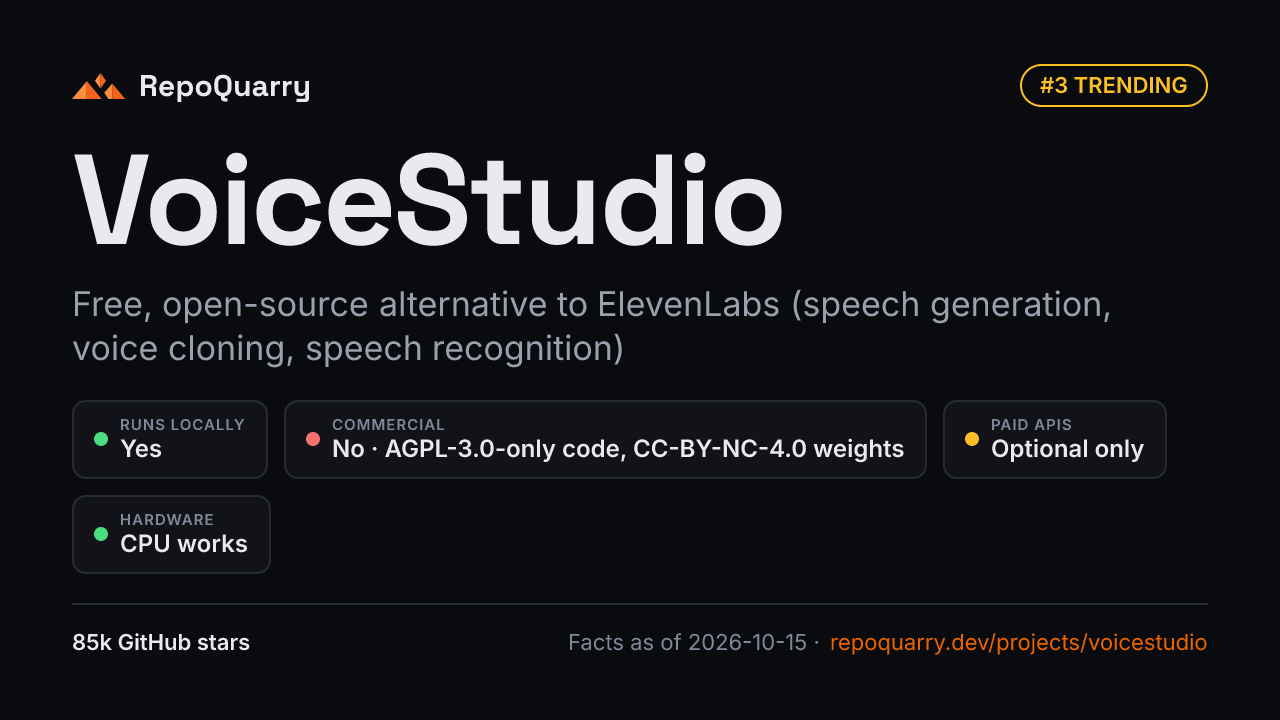
VoiceStudio is a free desktop app that clones voices, dubs video, transcribes speech and builds audiobooks on your own computer. On 25 October 2026 it had 85,019 GitHub stars, up 10,609 in seven days. Six months ago the repository did not exist.
It is the third most trending project on RepoQuarry this week, and the VoiceStudio page rates its growth as healthy. These are the numbers behind that label.
Stars: 37,473 in 27 days
| Measure | Figure |
|---|---|
| GitHub stars | 85,019 |
| Gained in the last 7 days | +10,609 (+14.3%) |
| Gained in the last 27 days | +37,473 |
| Forks | 9,412 |
| Repository created | 9 April 2026 |
By the afternoon of the 25th GitHub was already showing more than 86,000.
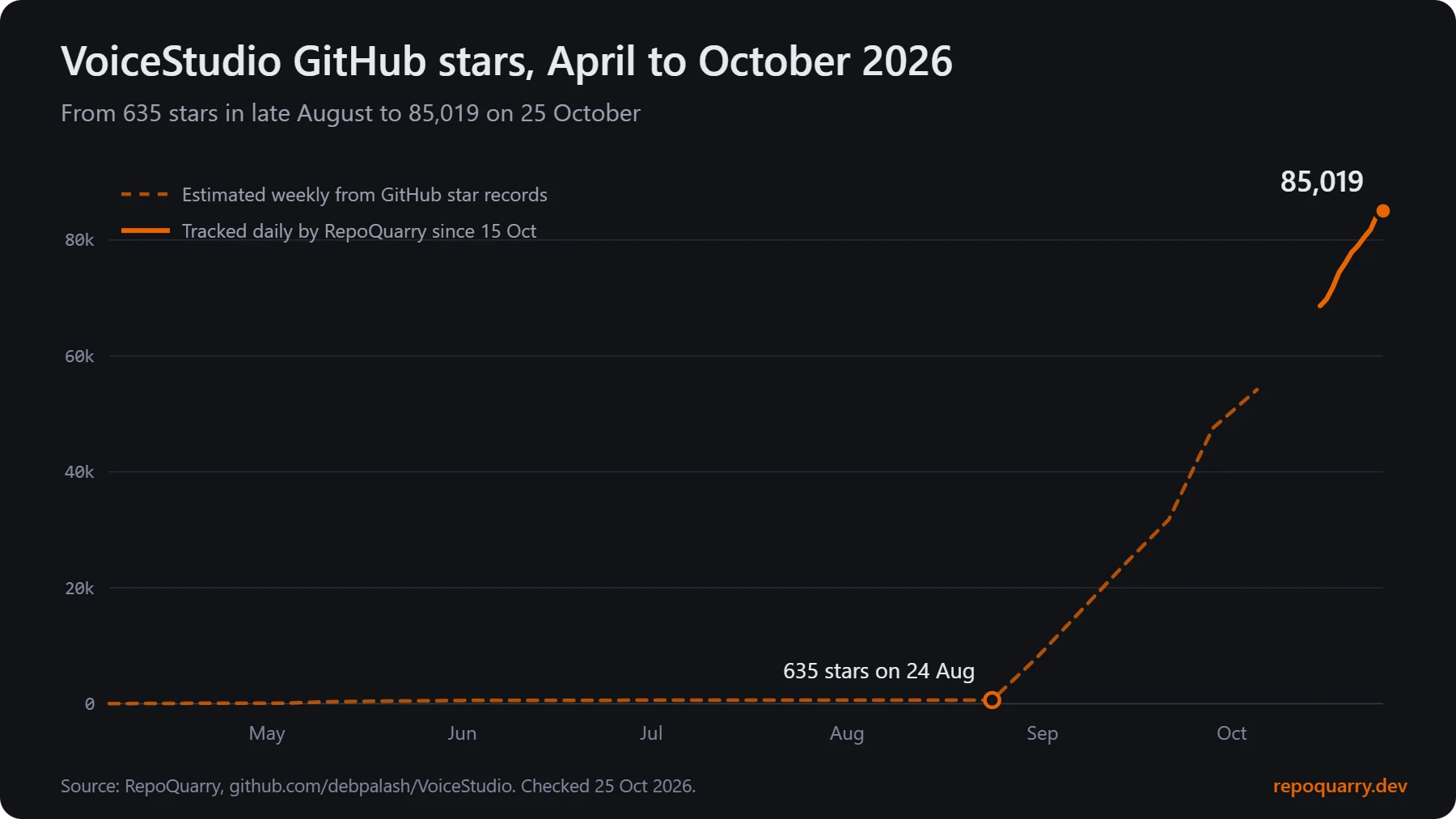
For its first four months VoiceStudio was a quiet project. On 24 August it had 635 stars. The climb started that week, alongside the v0.5.1 release on 28 August, and it has not slowed since.
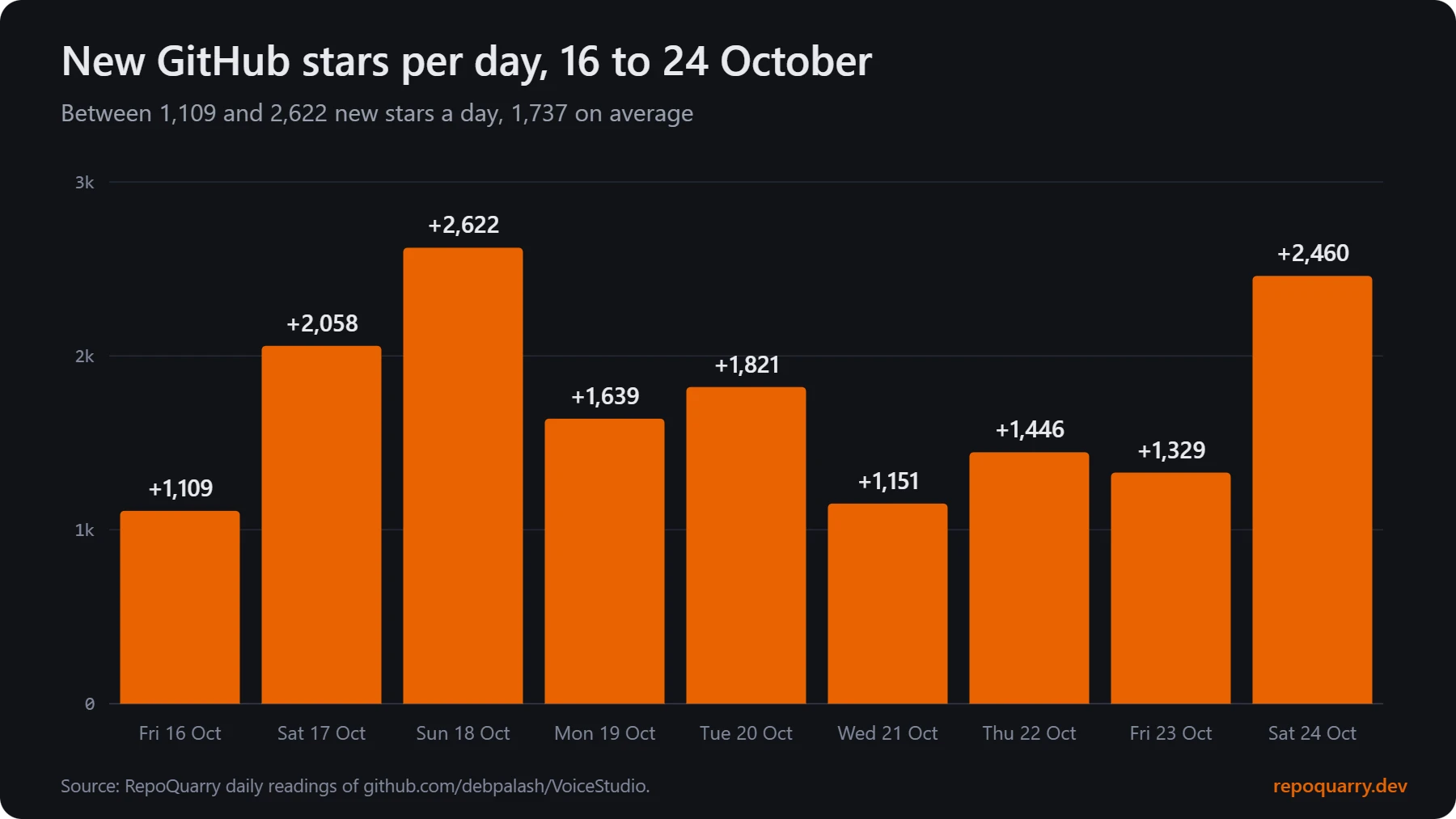
Every day we have tracked, at least 1,100 people starred it. The weekend days were the biggest, with 2,622 on Sunday 18 October and 2,460 on Saturday 24 October.
The chart on the project page carries a note: "not enough baseline history". RepoQuarry started recording VoiceStudio every day on 15 October. The dashed part of the line before that date is estimated from GitHub's public record of when each person starred the repo. Ten days of our own readings are too few to compare this week against a normal week for the project, so we hold back a "faster than usual" or "slowing" label until we have more. The 7-day and 27-day gains above are measured, not estimated.
Commits: 12 busy weeks in a row
The commit chart on our page covers the last 52 weeks. The first 22 are empty, because the project did not exist yet. Since the first commit in early April:
- commits landed in every single week
- the last 12 weeks had 2,459 commits, against 927 in the 12 weeks before
- the busiest week, starting 27 September, had 337 commits
- GitHub counts 5,156 commits on the main branch in total
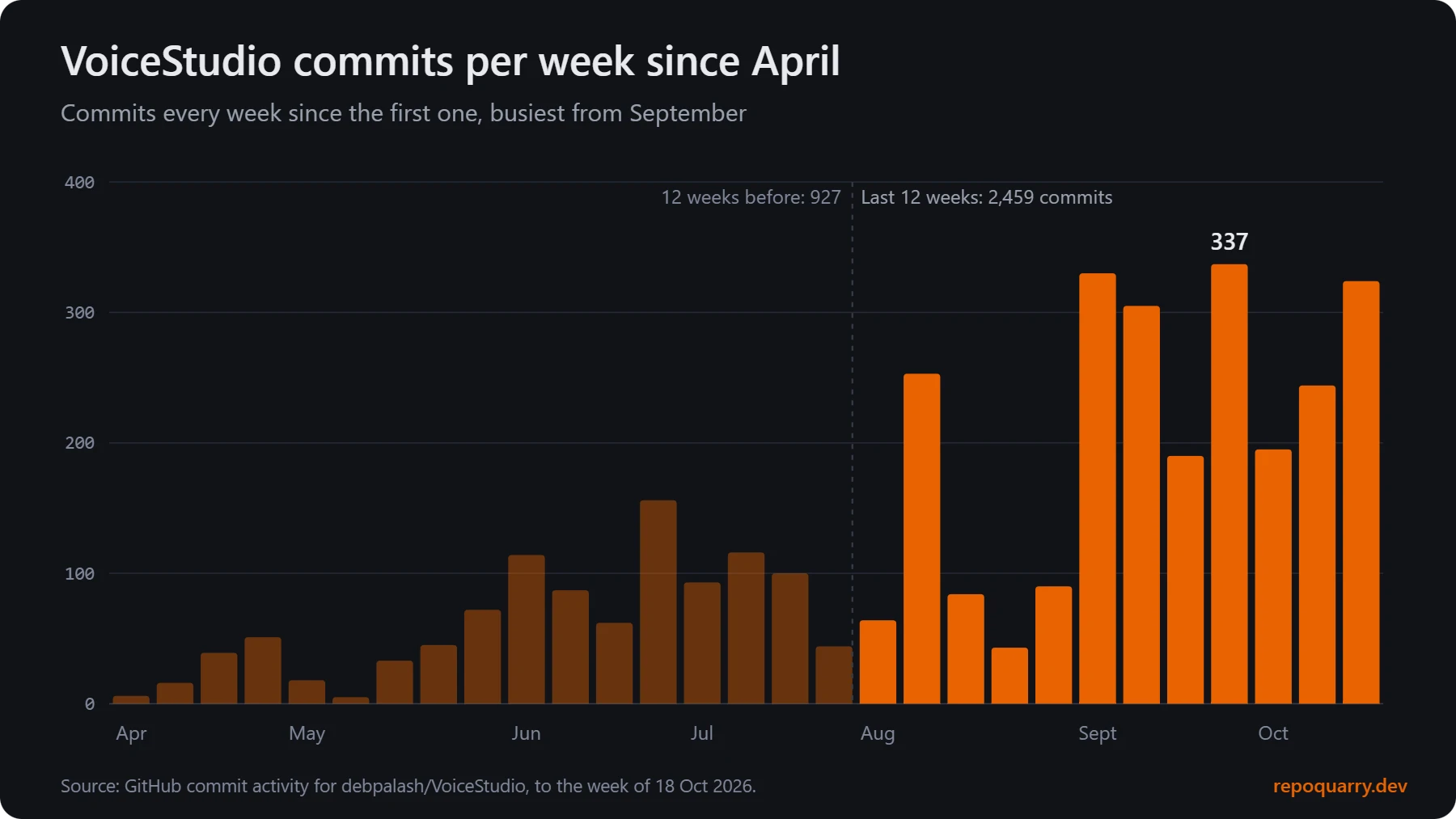
The work picked up before the stars did. The week of 9 August had 253 commits, three weeks ahead of the jump in stars.
Other people are doing more than starring it. In the last 30 days the project merged 268 pull requests, and 279 issues were opened against 274 closed. More than 100 people have committed code.
Most of the code still comes from two people. Palash Debnath has 3,722 commits. Shimul Debnath (velixio), listed with him as core team in the README, has 723. The next contributor has 58.
Releases
The pace shows in the release notes too:
- v0.5.3, 17 September: a new look, and a move from Tauri to Electron for the desktop app
- v0.5.4, 21 September: working engines and smoother long-form audio
- v0.5.5, 22 September: cross-language voice cloning
- v0.5.6, 23 September: the current stable version
- v0.5.7-beta.2, 23 October: a desktop beta, followed on 24 October by a mobile beta
Installers cover Windows, macOS on Apple Silicon and Linux, plus a Docker image. On Windows the one-line install is irm https://voicestudio.sh/install | iex in PowerShell. NVIDIA and Apple Silicon graphics speed things up. A processor alone works, slower, with about 5 GB of free disk. Intel Macs run the interface only and need a backend on another machine.
Who builds it
VoiceStudio is the work of Palash Debnath, a software engineer in Agartala, in northeast India. He has been on GitHub since 2013 and his profile bio lists him as CTO of Yupcha. The project started under the name OmniVoice Studio, after the k2-fsa OmniVoice model that is still its default engine, and the old name survives in the repo's topics.
In July he wrote Why I Built an Open-Source ElevenLabs. His case: a cloud voice service holds your voice on someone else's servers, charges by the second, and keeps the right to change its terms. He treats a voice as part of your identity and wants you to own the whole stack. When he wrote the post the repo had nearly 10,000 stars. It has grown more than eightfold since.
VoiceStudio is one of several apps he ships. His site also lists memxt (local-first memory for AI agents), Opal (a media player), Bootable, and Friday, a local voice assistant for Linux he is still building.
Follow him and the project here:
- Website: palash.dev
- X: @idebpalash
- GitHub: debpalash
- Project site: voicestudio.sh
- Code: github.com/debpalash/VoiceStudio
- Support the work: Ko-fi or GitHub Sponsors
Check the licence before you use it for work
For personal use, VoiceStudio replaces most of what you would pay ElevenLabs for: speech generation, voice cloning, transcription and dubbing. ElevenLabs paid plans start at $6 a month. VoiceStudio has no voice agents, which ElevenLabs sells.
Business use is different. The app code is AGPL-3.0, which allows commercial use if you share your changes. The default OmniVoice model weights are CC-BY-NC, which does not. So the setup you get out of the box is for non-commercial use only. Other engines in the app carry their own terms, and the project sells a commercial licence and Pro features if you need them. Our facts table links each of these to its source.
If you need voice cloning you can sell, GPT-SoVITS is MIT-licensed for both code and weights. For transcription alone, WhisperX adds word timings and speaker labels to Whisper.
We will update this post when the star chart has enough history for a proper trend. Follow VoiceStudio on RepoQuarry and we email you if its licence changes.