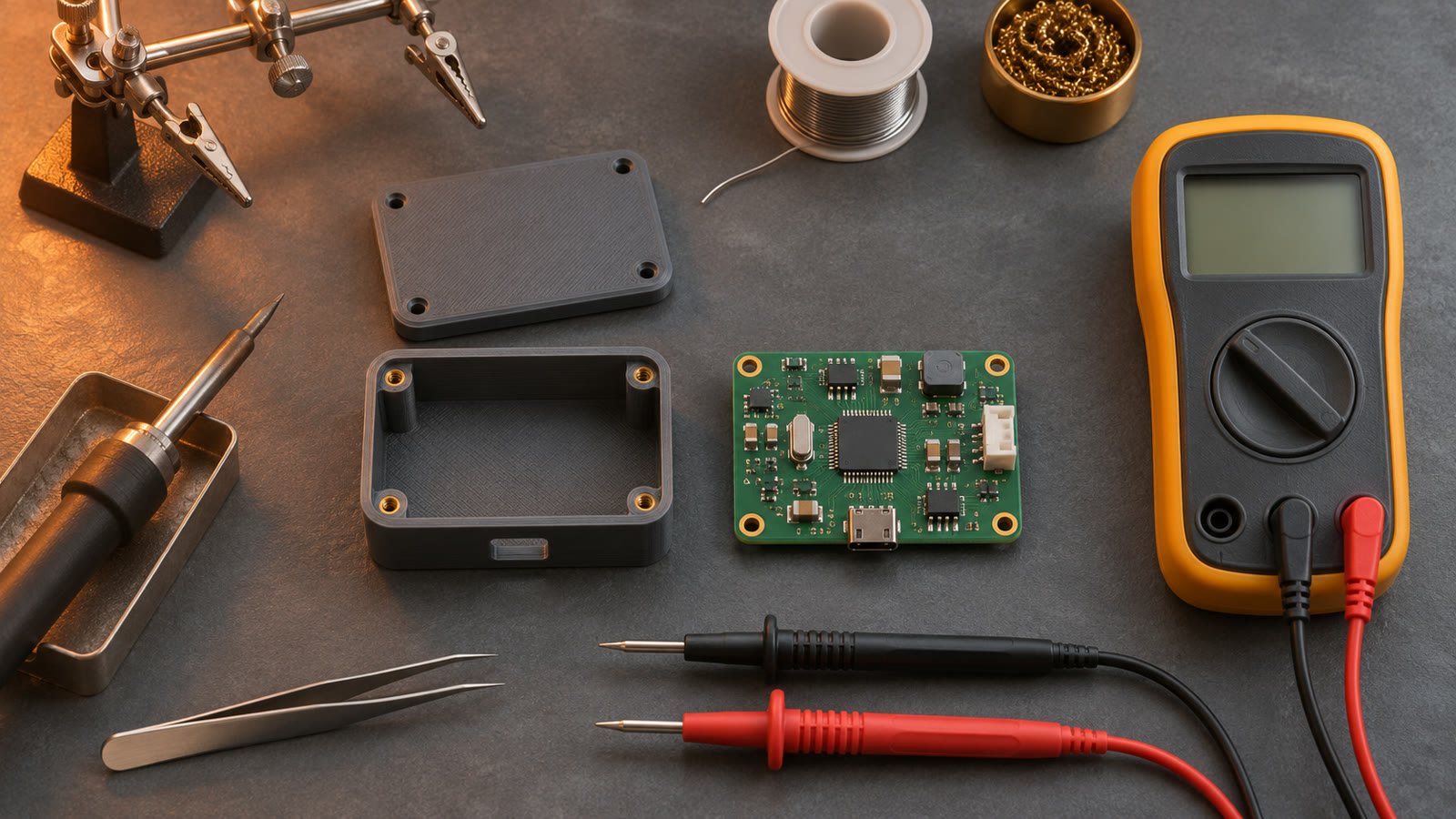
Cover and workbench illustrations by RepoQuarry.
On Riley Brown’s livestream, Claude Fable 5.2 turned a creative brief into a Blender short. In a separate experiment, engineers at Diode Computers built three working electronics prototypes from the same model’s designs. Both projects show a model keeping several tools and constraints in sync. Hardware gives that ability a much harder test: the parts have to fit, and the thing on the bench has to work. Riley Brown’s film and making-of · Anthropic and Diode’s electronics research
How good is Claude Fable 5.2?
Artificial Analysis measured Fable 5.2 at 65 on its Intelligence Index, up from 59 for Opus 5.5 at the same named Max effort setting, with default fallback in both tests. That’s a composite score across a set of evaluations. For a specific project, compare the models on time to an acceptable result, including retries, tool charges and your own review time. Anthropic’s standard API rates are $8 per million input tokens and $40 per million output tokens, twice Opus 5.5’s rates. Artificial Analysis comparison · Anthropic model and pricing docs
Brown’s The Edge is a good example of where the extra capability can matter. His 59-second film used Blender scripts, a webpage rendered onto the laptop screen in the scene, and a shared timeline to synchronise the typing, moving keys and sound. Brown reported $5.75 in cloud rendering charges. The model coordinated a production pipeline that included external tools and compute. Riley Brown’s original film · Brown’s production notes
What the circuit-board experiment showed
Anthropic and Diode gave Fable 5.2 short briefs for a USB speakerphone, a voice-assistant hub and a handheld virtual pet. The model produced schematics, printed circuit board (PCB) layouts, enclosure designs, firmware and parts lists. For the speakerphone it found that the mute switch would hit the case during assembly, tested a tilted insertion in its 3D model and updated the instructions. That detail shows why it matters to keep mechanical and electrical work connected. Anthropic and Diode’s research and prototype footage
Diode fabricated the boards, assembled the devices and tested them. The team reported that all three worked without circuitry fixes. These were early prototypes, with electrical validation, antenna tuning, thermal testing and certification still outstanding. Anthropic discloses a commercial relationship with Diode. Prototype results and limitations
The partners reported 69% on Diode’s internal PCB Gym, compared with 25% for the original Fable 5. The exercise involves putting components and connections back onto existing board designs with the layouts removed. They also reported 83.5% on BenchCAD 2.1, a public reconstruction benchmark. Both scores describe performance on defined design tasks. OpenAI’s separate handheld prototype shows another team making progress in this area. Its report also describes several rounds of manufacturing review and iteration. PCB Gym results · BenchCAD 2.1 release · OpenAI’s handheld prototype
Our 2027 prediction: more first-run boards
If agents cut the work between a device idea and a design someone can review, more makers and small teams could place a first prototype PCB order in 2027. I’d expect the effect to show up first in small batches for projects like desk sensors, custom controllers and test fixtures. Better review could reduce the number of revisions per project, so I’d watch first-time customers and distinct small-batch designs alongside repeat orders and total sales.
A surge across the whole PCB market is a much bigger claim. For September 2026, the Global Electronics Association reported North American PCB bookings up 229.4% year over year while shipments fell 6.4%. It pointed to data centres, networking, aerospace and defence as demand drivers and flagged material constraints. Those figures cover the association’s survey sample and reflect order and shipment values. The data to watch for this forecast are prototype-specific counts from fabricators over several quarters. Global Electronics Association’s September PCB report
For a first experiment, pick a low-voltage project with one job. Use open-source KiCad to inspect the schematic and layout, run its checks, then get a human review before ordering. Write down what you’ll measure on the first board. A useful result is a prototype you can test against that plan. KiCad documentation
Research credits: Mike Cretella, Connor Jennings and Brent Yi at Anthropic, and Craig Chen and the Diode Computers team, Riley Brown, Artificial Analysis, and the teams behind BenchCAD and KiCad.